
Do probiotics work in powder form?

Powdered probiotics are effective if they contain the right live strains and appropriate doses for your health needs. So the short answer is: they can be, but only when the label tells you how much you are actually getting.
Many protein powders and greens blends advertise probiotics on the front of the package while delivering a dose too small to do meaningful work, or bury the organisms inside a proprietary blend where individual amounts are never disclosed. Whether the probiotics in your protein powder are worth anything comes down to three things you can verify yourself: a stated CFU count, named strains, and individual amounts for each of those strains.
What Does "Contains Probiotics" Actually Mean on a Label?
Less than most shoppers assume. The widely accepted scientific definition describes probiotics as live microorganisms that, when taken in adequate amounts, confer a health benefit on the host.1 The operative phrase is "adequate amounts" — and the definition deliberately does not specify a number, because the adequate amount varies by strain and by the outcome being studied.1
That ambiguity leaves room for a labeling practice sometimes called fairy dusting: adding a token quantity of an ingredient so it can appear on the label, without adding enough to matter. A front-panel claim that a product "contains probiotics" is not a dose. It is a statement that some quantity, possibly a very small one, is present.
The fix is straightforward. Look for a number. If the label states a CFU count, the manufacturer has committed to something you can evaluate. If it does not, you have no basis for comparison at all.
How Many CFUs Does a Probiotic Need?
There is no universal threshold, and any brand claiming one is oversimplifying. A published review of dose-response relationships in human probiotic studies found that the evidence differs by outcome: some endpoints showed a clear relationship between higher doses and greater effect, while for others no dose-response relationship could be established from the available data.2 The author's conclusion was measured — absence of evidence for a dose effect is not the same as evidence that no dose effect exists.2
What this means practically: more is not automatically better, but very little is reliably worse. Products in the one-to-two-billion CFU range sit below the doses used in most human research, which makes it difficult to connect them to any documented outcome. Products that disclose counts in the tens of billions are at least operating in the range the literature has studied.
The more useful question is not "how many CFUs" but "how many, of what, and how do I know." A number without strain information tells you volume but not composition.
Why Strain Diversity Matters Alongside the Count
The gut hosts an enormous and varied microbial community, and an expert consensus panel has defined gut health as a state of normal gastrointestinal function without active disease or symptoms that affect quality of life.3 A single-strain product introduces one organism into that community. A multi-strain formula introduces several, each with different characteristics.
Strain diversity and total count are separate variables, and a label that gives you one without the other is only telling half the story. The most informative labels list each strain by name alongside its individual amount, which lets you see how the total is distributed rather than guessing.
How Do Popular Greens and Protein Powders Compare?
Applying those three checks — stated count, named strains, per-strain amounts — to widely sold products shows how much the category varies.
|
Product |
Stated CFU |
Strains |
Per-strain amounts listed |
| Digestive Vibrance |
100 billion |
8 |
Yes |
| Green Vibrance |
25 billion |
12 |
Yes |
| Maximum Vibrance |
25 billion |
12 |
Yes |
| AG1 Next Gen |
10 billion |
5 |
No — blend total only |
| Amazing Grass Super Greens |
1 billion |
Not stated on product page |
No |
The spread is wide enough to matter. The lowest and highest stated counts here differ by a factor of one hundred, and two of the five products give you a single blend figure rather than a breakdown you can evaluate strain by strain.
Figures taken from each manufacturer's own product page on August 13, 2026. Supplement formulas and labels change; verify against current packaging before relying on any comparison.
What to Look For on the Label
- A stated CFU count, not just the word "probiotics"
- Individual strains named, with amounts listed per strain
- Clarity on whether the count is measured at manufacture or guaranteed through shelf life
- No proprietary blends concealing the probiotic portion
- Prebiotic fiber or digestive enzymes in the same formula, which support the probiotics rather than sitting beside them
A product that passes all five is not necessarily the right one for you. But a product that fails three of them cannot be evaluated at all, which is a different and more serious problem.
Item three deserves a note. Probiotics in supplements are typically stored at ambient temperature, which can reduce viability compared with refrigerated storage, so manufacturers commonly build in an overage to deliver the target dose at the end of shelf life.4 A count measured at manufacture and a count guaranteed through expiration are different commitments — check which one a label specifies.
How Vibrant Health Discloses Probiotics
Vibrant Health lists every ingredient and every dose on the label, with no proprietary blends. That applies to the probiotic portion specifically, where each strain appears with its own amount rather than folded into a blend total. Three products in the line carry meaningful probiotic doses, and they are built for different jobs.
Green Vibrance — the daily foundation
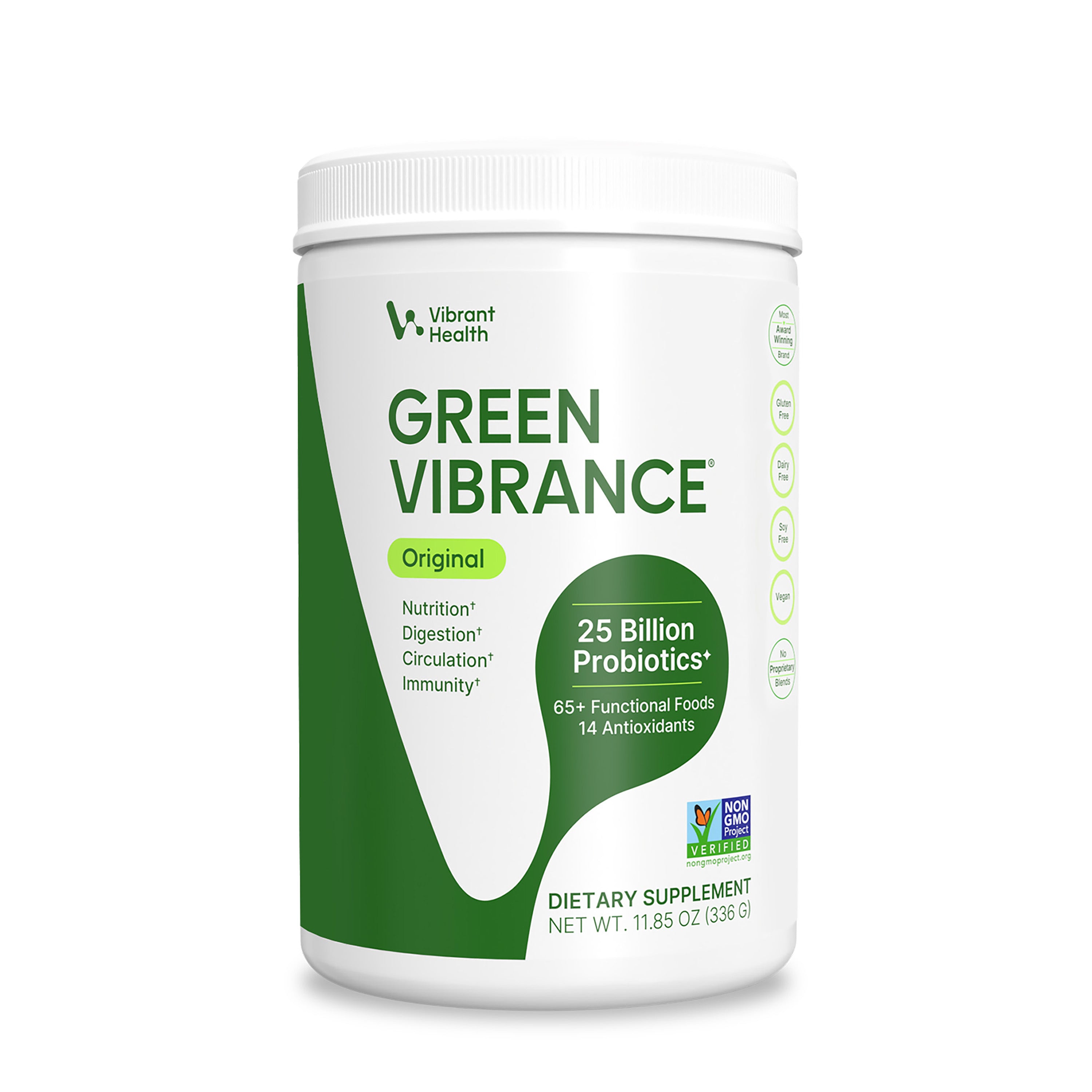
Green Vibrance delivers 25 billion probiotics from 12 strains per serving,* alongside cereal grasses, microalgae, a fruit and vegetable antioxidant profile, digestive enzymes, and prebiotic fiber in the same scoop. It is the broad daily option: micronutrient coverage plus a substantial probiotic dose, with no protein and no added calories to account for.
Choose this if you want one daily greens powder covering general nutrition and gut support, and you get your protein from food.
Maximum Vibrance — the same probiotics, plus protein
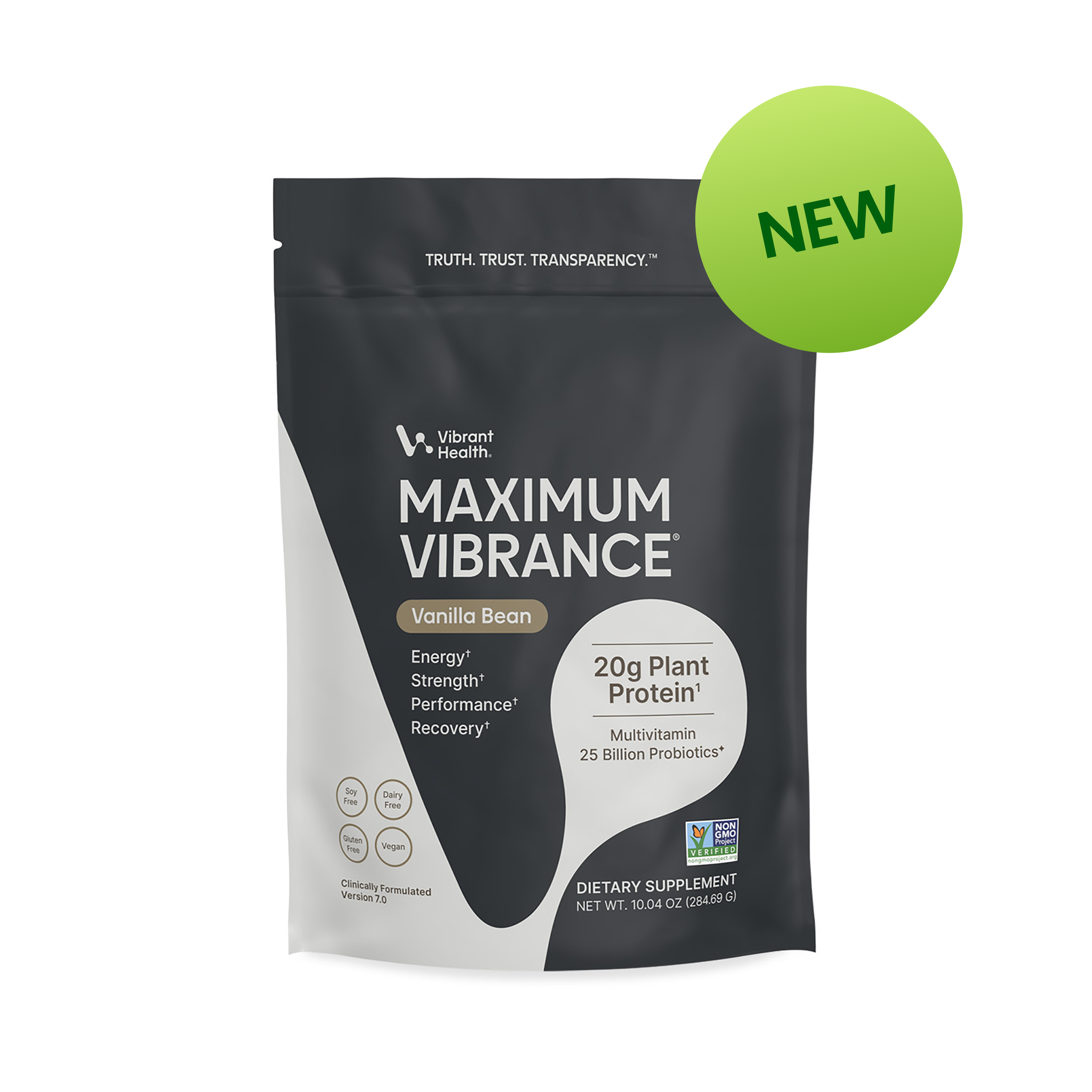
Maximum Vibrance is a plant-based meal shake with 20g of complete plant protein and 25 billion probiotics from 12 strains per serving,* built on more than 100 functional foods. It contains the ingredients found in Green Vibrance and adds plant-based protein, an organic multivitamin, and additional antioxidants — which is why the probiotic count matches while the rest of the formula does more.
Choose this if you want protein and probiotics in a single serving, or you are using a shake as a light meal rather than as a supplement alongside one.
Digestive Vibrance — targeted digestive support
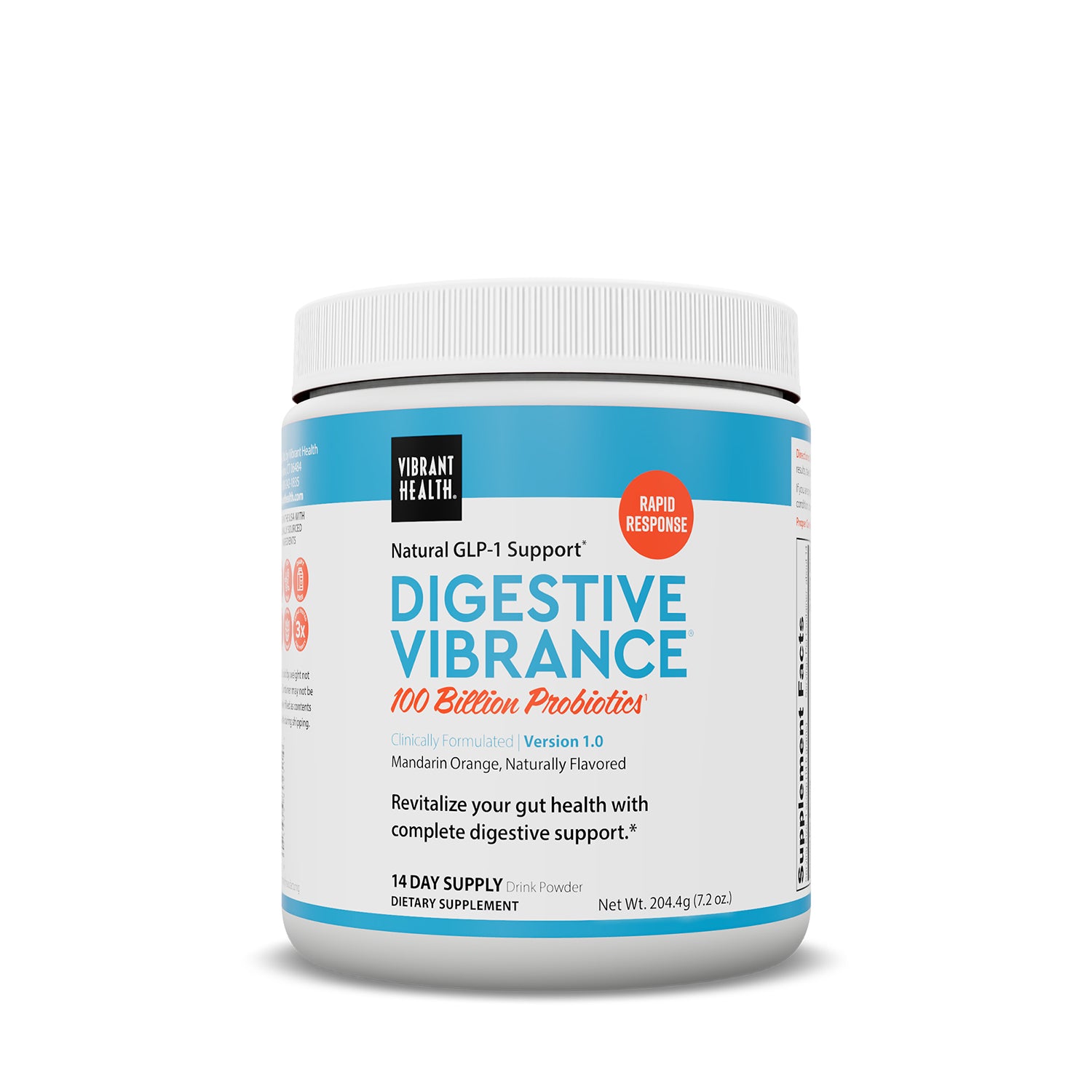
Digestive Vibrance is the high-potency option: 100 billion probiotics from 8 strains, 8.5g of prebiotics and fermentable fibers, digestive enzymes, and botanicals. It is designed to be taken consistently over a defined period, then reduced to a maintenance amount rather than run at full serving indefinitely.
Choose this if your priority is dedicated digestive support rather than probiotics arriving as one component of a broader daily formula.
Choosing between them
Green Vibrance and Maximum Vibrance are alternatives to each other, not companions — same probiotic profile, different surrounding formula, so the decision rests on whether you want the protein. Digestive Vibrance addresses a different need and sits at four times the probiotic dose. If you combine it with either greens formula, start at half a serving of each rather than a full serving of both, since each product supplies a substantial probiotic amount on its own.
*At date of manufacture.
The Takeaway
Probiotics in a protein powder are worth it when the label gives you enough information to judge them — a stated count, named strains with individual amounts, and clarity about when that count was measured. Probiotics listed without any of that are a marketing line, not a dose. The label is the whole test, and it takes about thirty seconds to apply.
 |
 |
 |
|
Shop Maximum Vibrance → |
Shop Green Vibrance → |
Shop Digestive Vibrance → |
Frequently Asked Questions
Do probiotics in protein powder actually work?
It depends entirely on the dose and the disclosure. Probiotics are defined as live microorganisms that confer a health benefit when taken in adequate amounts, and the definition does not fix what "adequate" means because it varies by strain and outcome. A protein powder that states its CFU count and names its strains can be evaluated. One that lists probiotics without a number cannot.
How many CFUs should a probiotic have?
Research has not established a single universal threshold, and dose-response relationships differ by outcome. Products in the one-to-two-billion range fall below the doses used in most human studies. Counts in the tens of billions sit within the range the literature has examined, though total count is only meaningful alongside strain information.
What does "at date of manufacture" mean on a probiotic label?
It means the stated CFU count was measured when the product was made, not guaranteed through its expiration date. Because probiotics lose viability during ambient storage, manufacturers often include an overage to compensate. A count measured at manufacture and a count guaranteed through shelf life are different commitments, so it is worth checking which one a label specifies.
Is it better to have more probiotic strains or a higher CFU count?
They are separate variables and neither substitutes for the other. A high count concentrated in one strain and a moderate count spread across many strains are different products. The most useful labels list each strain with its individual amount so you can see how the total is distributed rather than inferring it.
Do I need a separate probiotic if my protein powder already has one?
Not necessarily. If your protein powder discloses a meaningful CFU count from multiple named strains, it may cover your daily needs. People looking for dedicated digestive support often choose a higher-potency standalone formula instead. If you combine products that each contain substantial probiotics, consider starting with partial servings of each.
Do probiotics need prebiotics to be effective?
Prebiotic fibers are substrates that beneficial gut bacteria use, and formulas pairing probiotics with prebiotic fiber are designed so the two work together. Digestive enzymes serve a different function, supporting the breakdown of food into absorbable nutrients. A formula containing all three is doing more than one that lists probiotics alone.
Sources
- Hill C, Guarner F, Reid G, et al. Expert consensus document: The International Scientific Association for Probiotics and Prebiotics consensus statement on the scope and appropriate use of the term probiotic. Nature Reviews Gastroenterology & Hepatology. 2014;11(8):506-514. https://www.nature.com/articles/nrgastro.2014.66
- Ouwehand AC. A review of dose-responses of probiotics in human studies. Beneficial Microbes. 2017;8(2):143-151. https://pubmed.ncbi.nlm.nih.gov/28008787/
- The International Scientific Association for Probiotics and Prebiotics (ISAPP) consensus statement on the definition and scope of gut health. Nature Reviews Gastroenterology & Hepatology. 2026. https://www.nature.com/articles/s41575-026-01176-x
- Fenster K, Freeburg B, Hollard C, Wong C, Rønhave Laursen R, Ouwehand AC. The production and delivery of probiotics: a review of a practical approach. Microorganisms. 2019;7(3):83. https://www.ncbi.nlm.nih.gov/pmc/articles/PMC6463069/
This article is for informational purposes only and has not been evaluated by the FDA. This product is not intended to diagnose, treat, cure, or prevent any disease.
Why Trust Vibrant Health?
At Vibrant Health, we've been pioneers in science-backed nutrition for over 30 years, formulating transparently sourced superfood supplements that prioritize real results. Our blog is an extension of that commitment—a trusted resource for expert-driven wellness insights.
Every article is crafted with nutrition expertise, backed by the latest scientific research, and reviewed by our in-house Certified Health Coaches and Product Educators. We break down complex health topics into practical, actionable advice—helping you make informed choices about superfoods, supplementation, and holistic wellness. As a brand that has earned thousands of 5-star reviews and the trust of health professionals, we ensure that our content reflects the same quality, integrity, and transparency as our products.
Your wellness journey deserves accurate, credible, and empowering guidance. That's why Vibrant Health's blog is here—to help you live a healthier, more vibrant life, backed by real expertise
Jodi Schneider
Certified Health Coach and Product Consultant at Vibrant Health
Jodi Schneider is a Certified Health Coach and Product Consultant at Vibrant Health, with a Nutrition and Healthy Living Certification from Cornell University. For nearly six years, she's helped customers navigate their wellness journey, making nutrition simple and approachable. Passionate about holistic health, she believes wellness is about balance—nourishing the body, staying active, and caring for emotional well-being. Outside of work, you'll find her hiking with her dogs, meditating, or fueling her day with Spectrum Vibrance
Next to Read
Science
Which Form of Zinc Should You Take?
Zinc labels list the form in the fine print, and it matters less than you'd think. Here's how oxide, gluconate, citrate, glycinate, and picolinate compare in human studies, where the research runs thin, and which habits shift absorption as much as the form you buy.
October 05, 2026
RecipesHow Do You Make a Low Sugar Green Smoothie?
Most green smoothies are really fruit smoothies with some spinach added. If you want yours less sweet, split up the two jobs fruit does. Frozen vegetables and a little fat handle texture. Berries, citrus, and spice handle flavor. Here's the build, plus one frozen-vegetable safety step most recipes skip.September 28, 2026
RecipesWhat Goes in a Post-Workout Greens Smoothie?
A post-workout smoothie needs protein, carbohydrate, and fluid. A greens powder isn't any of the three, and building the shake around it is how people end up with something that doesn't do the job. Here's the order that works, and where greens genuinely fit.
September 21, 2026

Start Feeling Your Best Today
You know what we stand for, now it’s time to experience it for yourself. Start your wellness journey with trusted formulas that support real, lasting change.

Free Shipping on Orders $55+
Skip the fees—shipping's on us when you spend $55 or more.

30-day Satisfaction Guarantee
Not feeling the difference? Return it within 30 days—no questions asked.

Subscribe & Save
Stay consistent, save money—get your favorites delivered on your schedule.
As Seen In


